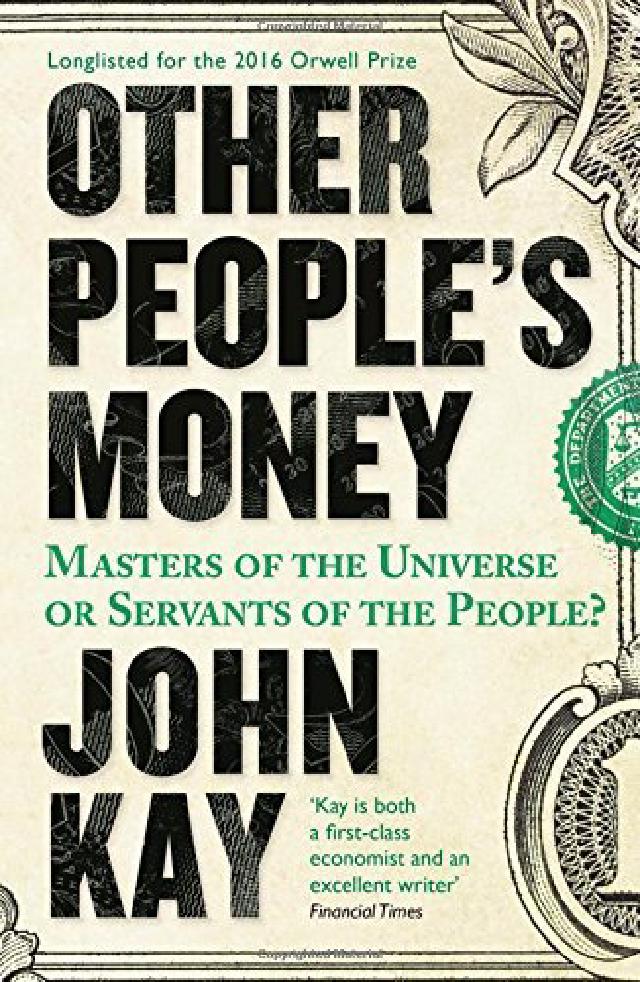
‘I’ll be gone, you’ll be gone.’
That supposed shibboleth of the turn-of-the-century captains of finance, whose unrestrained pursuit of profits led western economies to the brink of collapse less than two decades ago, provides a suitable refrain to this review of the financial services industry.
Auf irgendeiner Ebene sind uns die Eigenschaften der menschlichen Natur, die „Thinking, fast and slow“ erläutert, schon bekannt. In unserer Gesellschaft wird die Vernunft und die rationalen Handlungen der Menschen gerne hervorgehoben, Attribute, durch die wir uns sehr gerne gegenüber unseren sonstigen Verwandten im Tierreich einen besonderen Standesdünkel gönnen. Doch wie in diesem Buch so meisterhaft dargestellt, gibt es eine beträchtliche Menge an Faktoren, die unsere scheinbar so vernünftigen Entscheidungen verdrehen und beeinflussen können. Laut Kahneman kann man diese zwei so unvereinbaren Aspekte unseres Wesens als getrennte Systeme betrachten: Das erste System verkörpert unsere gedankenlosen, selbstständigen, unterbewussten und reflexartigen Reaktionen, wogegen das zweite System das logisch handelnde und vernünftige Dasein vertritt, wofür wir uns Menschen eigentlich halten. Viele der Forschungsarbeiten und Ergebnisse, die in diesem Buch behandelt werden, hat Kahneman zusammen mit seinem verstorbenen Kollegen Amos Tversky selbst durchgeführt. Ihm ist das Buch auch gewidmet.
The qualities of human nature described in “Thinking, fast and slow” are already known to all of us at some level. We are all taught in society to believe in the rational, thinking human being as distinct from his animal peers, yet at this book excellently details, there are plenty of ways in which our seemingly rational decisions can be bent and perverted by various forms of bias. Daniel Kahneman details these two seemingly incongruous facets of our nature as two ‘distinct’ halves: System 1 represents our autonomous, unthinking, reflex and subconscious reactions, whereas System 2 is that logical, calculating being we consider ourselves to be. Much of the relevant research covered in this volume was pioneered and conducted by Kahneman and his late colleague Amos Tversky, to whom this volume is dedicated.
MEXIKO hat 11 Milliardäre, der Zeitschrift Forbes zufolge. Zehn werden oft bei Benefizdinners und anderen vornehmen Veranstaltungen lächelnd fotografiert. Der Elfte, Joaquín Guzmán Loera, hat ein ziemlich unähnliches Porträtfoto. Abgebildet in einem billigen Anorak sieht man ihn fröstelnd im Regen binnen der Betonmauer eines Hochsicherheitsgefängnises. Besser bekannt unter seinem Spitznamen El Chapo („der Kleine“) ist Herr Guzmán durch die vermutete $1 Milliarde, die er als Geschäftsführer des Sinaloa-Drogenkartells verdiente, ein von Lateinamerikas erfolgreichsten Exporteuren. Seitdem er 2001 versteckt in einem Wäschewagen aus dem Gefängnis ausbrach, gibt es wenige Fotos von El Chapo.
President Truman famously kept a sign on his desk that said “The buck stops here”, a gift from an avid poker player. Yet whilst we might appreciate the imagery and the sentiment, should we really rely on there being a ‘buck
’ to pass? Is there always a man in charge, someone with whom the ultimate responsibility lies? The public at large like to believe so. Having someone who is nominally in charge provides a feeling that there is some level of control over daily events, that there is some direction to the madness that seems to govern our lives. It isn’t particularly important whether that person you believe in is God, the president, the Führer or Chuck Norris. Nor does that responsible person need to be an individual, it can just as easily be taken as being particular position, a group of people, or an organisation.
Yet having someone to look to as the ‘Man in Charge’ also entails having someone to blame when things go wrong. In general, people are not willing to look at events as the result of complex systems of uncountable interconnected threads. Such systems lack palpability, they invoke confusion and lack obvious conclusions. Much easier to view events as the result of simple inputs and outputs, revolving around the decision-making roles of important personages. When the proverbial hits the fan, the easiest response is to find those at the helm, whether particular individuals or a group, and lay the blame as thick and fast as the cement mixers can provide it. It’s a simple and effective reaction, since any person that can be held culpable must have made decisions, and any decision can be deemed retrospectively fallacious. Ergo any individual can be made and held responsible. ((We should not forget, of course, that as much as we enjoy seeing certain individuals as being responsible for the workings of the world, both for the comfort it gives us whilst things are ticking along smoothly, as well as the convenience of having someone to blame when they don’t, the individuals themselves also enjoy a level of revelry in the illusion that they are the ones with all the answers.))
I recently came across a wonderful idea for providing peer-to-peer lending to entrepreneurs in developing countries. The idea seems akin to the principles of the Grameen Bank, providing microcredit in this case primarily as a form of aid. The system allows people with spare cash to browse potential applicants and offer them money in the form of a loan. Kiva works with what they term experienced ‘field partners’ to provide the loans, these bodies being established and recognised sources of finance (which may charge interest on the money to the borrower). Eventually the loans are repaid and the money can be withdrawn, redistributed or donated to Kiva to help cover their organisation’s costs. Of course the levels of finance are fairly miniscule on the larger scale, a far cry yet from providing the many milliards needed to create the level of sustainability needed in many parts of the developing world, through stability, infrastructure, education etc. Yet Kiva has plenty of room to expand, and importantly the principle behind the organisation is sound, in trying to create a direct link between people in the developing world who need capital (and know what they want to do with it) and those with the money and the conscience to try and help. Time will tell how effective Kiva’s mission will be.
There are very few today who would deny that the quality of our food has dropped, partly as a result of the change embodied by the death of the local shop and the rise of the supermarket. Where once the only change was that our food was pre-grown, now we find it has been pre-grown, pre-made, pre-cooked, pre-packaged, pre-distributed, and often find our purchases are precluded by lack of choice for good measure. Of course, supermarkets are the just one example of today’s monopolies, that much should be clear. Enter the store at one end, and you can start your purchases with your baby food at one end, and walk all the way through life till you need find a buy-one-get-one-free headstone and a “Value” lawyer to deal with your wills and probate. Plus the stores are so big these days that you might in fact need the coffin by the time you finally leave.
We should be clear about one thing. In-game advertising isn’t new. And not just the self-effacing, tongue-in-cheek form of advertising epitomised by the Loom™-toting pirate in LucasArts’ The Secret of Monkey Island. Anyone who remembers Zool from the early 1990s might recall the Chupa Chups sponsorship deal, and the FIFA series has been using advertising on their billboards for many years, though what with ‘image rights’ being big money for clubs and players alike, the football genre could be said to have entrenched itself in the realm of ‘reverse’ advertising.
Nevertheless, the presence of advertising in games has been pretty low key, considering the industry’s growth over the past decade or so. Advertising is not usually so slow to find its way into new forms of media entertainment, Internet advertising being the biggest example of recent times. So the news
that in-game advertising rights for Counter-Strike (the ‘big one’ as far as non-MMORPGs is concerned) have been sold to IGA should only come as expected. Previously adverts for Valve’s flagship had been reserved for brief loading screens, an idea which apparently never took hold. Where Internet advertising has had much reaction to the point where many people block out adverts as a matter of course, this will be more difficult to achieve in such a gaming environment, and should it succeed, might result in future games featuring truly hard-coded advertising avenues.
Apparently, getting what you paid for isn’t necessarily the name of the game any more. Although I was well aware of it at the time of purchase, no niggly smallprint or obligatory T&C which no one reads hid this caveat, it still comes as something of a surprise to be informed that something I paid for disappeared if I don’t use it. In my personal experience, Skype hasn’t done itself many favours in terms of maintaining a decent service. Certainly, it ‘does what it says on the tin’ the majority of the time, indeed it was only as I decided to test Skype’s SkypeOut feature (which worked handsomely, to the company’s credit) that I came across this email. This quote, in particular, amused: