
2016 in Review
Twelve months down the line, I thought I’d post another year in review
. Again, this post won’t be of any interest to anyone, but here’s a summary of some of the media I’ve consumed over the past year.
11 minutes to read
Reading this post recently, I found myself asking why ebooks haven’t really taken off as a medium. Certainly more recent efforts, such as Amazon’s Kindle, have helped to reignite the market after a rather dubious development period over the past decade or so, but if one compares the ubiquity of mobile phones or digital audio players, e-books are entirely missing from the landscape. ((According to The Guardian in April 2008, ebooks accounted for less than 1% of the total publishing market, albeit this share has no doubt increased since.))
In purely utilitarian terms, should the technology ever be fully and appropriately used, ebooks have a lot to offer over their paper counterparts. There are far fewer requirements and resources needed for production, and distribution is much easier. Whilst a device on which to read ebooks might outweigh a single volume, additional books add nothing, and in terms of transporting books en mass, ebooks are clearly in favour. The ability to flick through a paper volume might be lost in the electronic form, but this is clearly compensated for by vastly improved tools for search and cross-referencing. Likewise combining other forms of media such as video and audio is a perfectly reasonable conception with ebooks, that the paper variety can’t really compete with on any level. They’re also more easily manipulable, in terms of being able to zoom, highlight or simple leave your own annotations about the place. All of which is to say nothing of the potential advantages for newspapers and other periodicals.
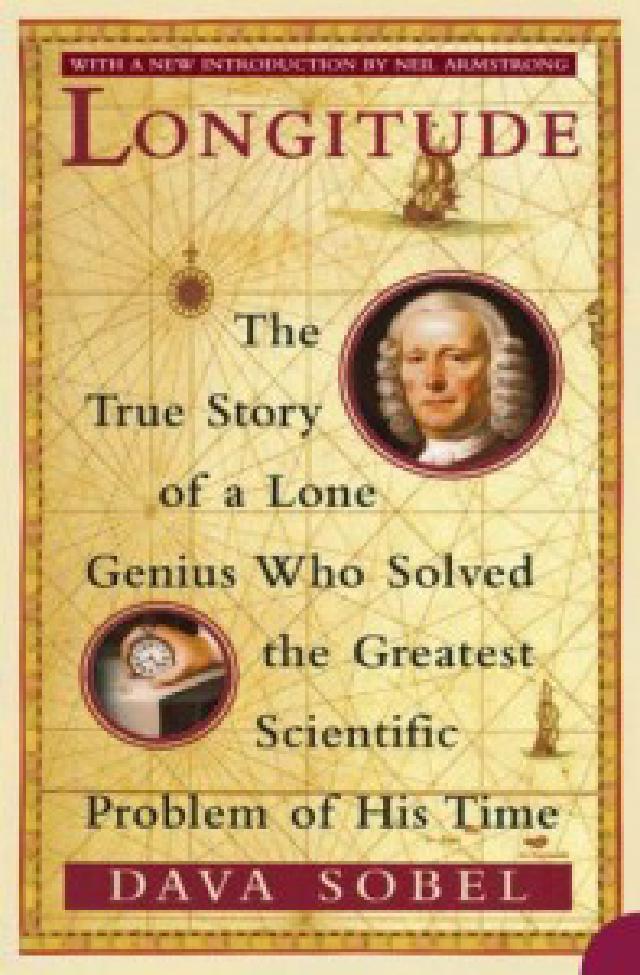
Longitude
In Phantoms in the Brain, V. S. Ramachandran has attempted to emulate the forebears he cites in the Preface, who inspired him to write science that is both informative and interesting to the general reading public. In this he has certainly succeeded, his style is highly approachable, and the content not only comprises interesting titbits, but wholly thought-provoking suggestions and analyses. I picked up Phantoms in the Brain on the basis of a recommendation from a friend more involved in the scientific fold than I am, yet found the book to be readily accessible to these with even only a meagre understanding of the way our brains function.
The book is for the most part concerned with the fundamental inner workings of the brain revealed to us through curiously specific medical conditions, often brought about by severe physical traumas such as strokes. Some of the findings are, perhaps, fairly well known by now, yet I’ve no doubt that many will still be quite shocking to most readers. However, Ramachandran keeps the presentation of both old and new findings fresh, in his natural inquisitive approach to each individual problem. His curiosity and novel attitude in dealing with many of these strange rarities of medical science at times remind one of the naïve questioning of a young child, who by approaching problems from altogether unexpected angles can come up with profound thoughts and solutions that would not normally strike an adult.
As an avid reader, it often occurs to me just how second-hand book retailers manage to turn a profit. Even assuming the raw stock can be acquired at very little cost, the vast majority of books can go unsold almost indefinitely, all the while occupying shelf or storage space that costs money to maintain. I read somewhere that on average a second-hand bookseller can expect a third of his stock to be sold within six months, another third to be sold on an indefinite timescale, and the final third to simply go unsold. Obviously this has a knockon effect where turnover is slow. On a recent trip to Wigtown , Scotland’s National Book Town, I came across plenty of bookstores that clearly have to elevate prices to remain profitable. No doubt in their case, the annual book festival and holiday season are a major source of revenue that would otherwise cause most to close their doors in an otherwise small and overcrowded market ecosystem.
ZebrasNoble—but undomesticable?
How do you domesticate a zebra? You can’t, or at least that’s the justification put forward by Jared Diamond in his Guns, Germs and Steel for why these wild beasts were never used as draught animals or cavalry in sub-Saharan Africa. Much of what Diamond writes has a logical ring to it, and whilst the evidence is sparse and in places contradictory, his conclusions fit the necessarily teleological approach. Others have accused him of too much geographical determinism, and perhaps they have a point, but the one thing which struck me as being peculiarly out of place in Diamond’s writing was his treatment of Africa’s wild animals as being unsuitable for domestication. He argued that it was only by chance that Eurasia benefited from having suitable species such as goats, sheep, cattle and horses, and that the native varieties of these animals in sub-Saharan Africa were inherintly unsuitable.
Book spinesBook spines
Ever wondered why the spines on your books and DVDs aren’t all oriented the same way? Why some read top-to-bottom and others read bottom-to-top? Admittedly, this phenomenon is rare with books printed in the Anglophone world, where the top-to-bottom approach is preferable, but take a look at a bookshelf in continental Europe and you’ll probably find the titles read the other way (or both, according to Wikipedia ).


