logo

A Mind @ Play

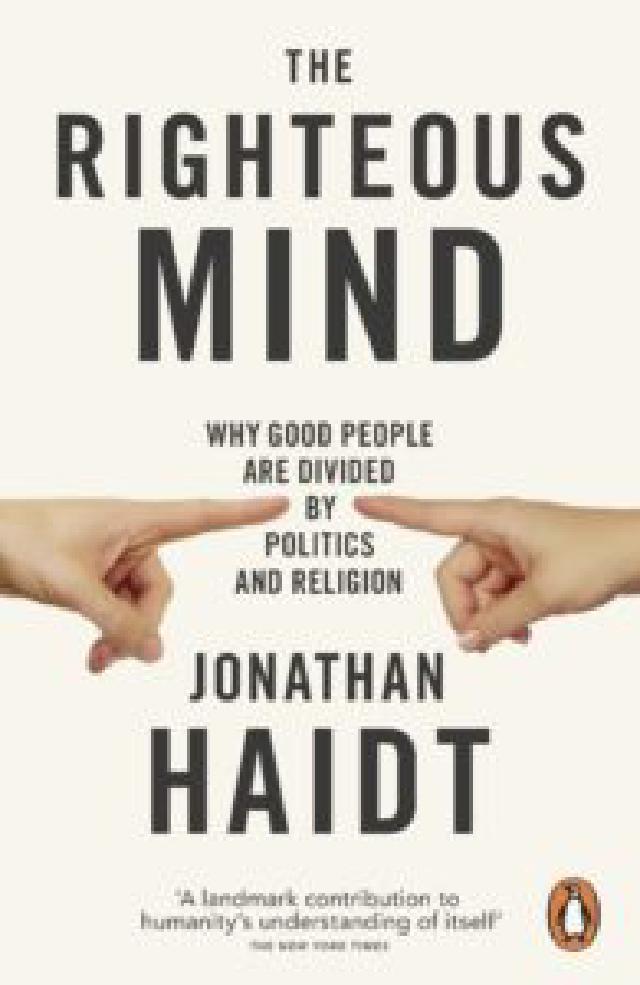
The Righteous Mind: Why Good People are Divided by Politics and Religion

Surveying today’s political landscape, it’s easy to suppose we’re approaching a precipice. Passionate intransigence divides societies into blocks which, even where decidedly secular, are rallied around with religious fetishism. It seems that ideological boundaries are increasingly hardening, poisoning the political dialogue, preventing constructive discourse and contributing to almost maddening levels of senseless blustering.

In The Righteous Mind, social psychologist Jonathan Haidt investigates the concept of morality and shows how differing political groups can reach such disparate conclusions from the same starting point. Gradually building up his argument, Haidt succinctly retreads a lot of territory covered elsewhere in more detail, but which is vital to understanding his standpoint.

3 minutes to read
The Man Who Mistook His Wife’s Head for a Hat

The Man Who Mistook His Wife’s Head for a Hat

What happens when we are no longer able to recognise objects, but there’s nothing wrong with our ability to see? When we lose our sense of self and no longer feel the body we’re in? When the concept of ‘leftness’ is severed from our reality?

Oliver Sacks describes cases involving all these issues and more in a classic survey of ‘losses’ and ‘excesses’ in the human brain. The patients are a fascinating array of characters each suffering from such unusual problems that the symptoms seem almost comical. The eponymous man who failed to identify his wife’s head suffered from a form of visual agnosia , leaving him incapable of identifying objects, although his visual acuity was not impaired. Another sufferer had lost all ability to form new memories, and indeed was stuck at some point in his past, incapable of progressing past that point.

2 minutes to read
The Blind Watchmaker

The Blind Watchmaker

Blind Watchmaker
What is it about the theory of evolution which makes it so difficult to comprehend? Why does it require a leap of faith for many people to understand? And why do they feel they need to believe in evolution in a way they never would with, say, gravity?

Having finally got around to reading The Blind Watchmaker this year, one remark really stuck in my mind, when Dawkins turned to describing the human experience in terms of units. The way we perceive the world around us is intrinsically bound to the way we encounter it. We consider time, for instance, within a fairly specific range. Once we go beyond that range, our natural, indeed evolutionary faculties are incapable of perceiving the world outside those bounds with any degree of accuracy. That’s not to say we hit a brick wall when we step beyond that range. We’re still perfectly capable of contemplating the meaning of extremely long or short timescales, for example. We can measure them, compare them, calculate them; we can analogise and use metaphors. But we are far from being able to really grok what they mean.

4 minutes to read
The Numerati: How they’ll get my number and yours

The Numerati: How they’ll get my number and yours

The Numerati
Recent springs and bounds in technology have opened the floodgates to a wealth of information that once required millions of man-hours to collect, collate, evaluate and assess, if indeed it ever happened at all. Now all of that can be handled, stored and processed by computers, constantly being fed by millions of users who are often happy to give up snippets of their information for the tiniest of benefits. But what hidden potentials lie waiting among those mountains of bits and bytes? And who are the people forging the algorithms to find those golden nuggets?
4 minutes to read

Uncommon People: Resistance, Rebellion and Jazz

Uncommon People is a collection of Eric Hobsbawm’s essays spanning the majority of his long career, from the 1950s to the mid-1990s. It brings together a wide range of topics, collected under four headings: The Radical Tradition, Country People, Contemporary History and Jazz.

Under “The Radical Tradition”, there are essays addressing Thomas Paine, the Luddites, the radicalism of shoemakers, the difference between labour traditions in France and Britain, the development of a distinctive working class culture, the skilled manual wage worker in Victorian moral frameworks, the iconography of male and female representations in labour movements, the origins and history of May Day as a working class celebration, the relationship between socialism and the avant-garde, and Labour Party stalwart Harold Laski.


3 minutes to read

Exorcising Hitler: The Occupation and Denazification of Germany

The period in German history following the Second World War is probably one of the most neglected in terms of popular history, far overshadowed by the war itself and frequently overlooked as a mere footnote to the origins of the Cold War. Yet the fascinating question remains as to why the peace following the First World War contributed to the beginnings of the Second, whilst the policies following the latter led to one of the longest periods of peace on the continent.
4 minutes to read

Selling Hitler: The Story of the Hitler Diaries

In Selling Hitler Robert Harris has provided an enthralling, blow-by-blow account of one of the most infamous hoaxes in history, the alleged discovery of the Hitler diaries. A potentially convoluted plot with many actors, Harris has done a remarkable job in organising the story in a comprehensible manner, and in so doing has simultaneously written a turn-paging piece of investigative journalism, full of interesting nuggets and occasionally humourous asides.
4 minutes to read

Nightfall One

As one of the world’s most prolific authors, and one of the true giants of science fiction, it can be difficult to know where to start with Asimov. As a child I read a few stories and was soon hooked, but perusing his oeuvre takes some time. For anyone interested in wetting their fingers with this master of science fiction, however, the Nightfall anthology is a great place to start.
2 minutes to read

Nightfall Two

As one of the world’s most prolific authors, and one of the true giants of science fiction, it can be difficult to know where to start with Asimov. As a child I read a few stories and was soon hooked, but perusing his oeuvre takes some time. For anyone interested in wetting their fingers with this master of science fiction, however, the Nightfall anthology is a great place to start.
3 minutes to read